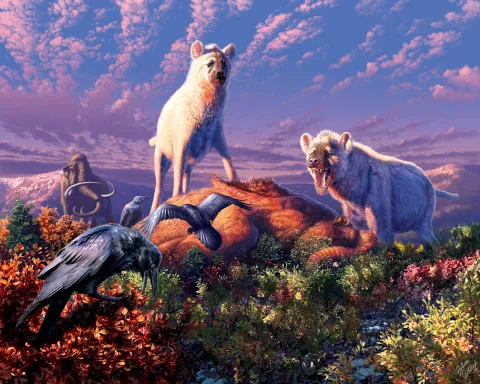
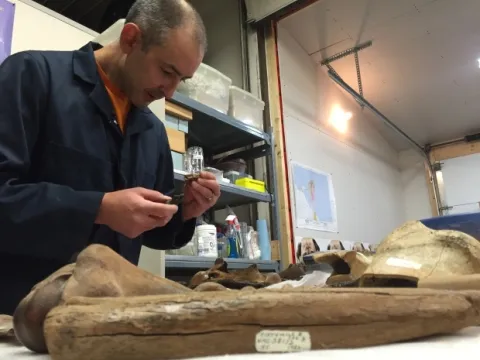
At the Beringia Centre, we’re fortunate to work with some truly incredible women in science; women whose curiosity, expertise, and dedication help bring Yukon’s past to life every day. To celebrate the International Day of Women and Girls in Science, we asked three of our colleagues, Elizabeth Hall, Jodie MacMillan, and Susan Moorhead Mooney, to share their perspectives as women who have worked in archaeology and palaeontology.
What do you love about your job?
Elizabeth - I love identifying bones. I like the challenge solving of who and what a bone fragment is. It can be a mystery and puzzle in one, it is both stimulating and fun.
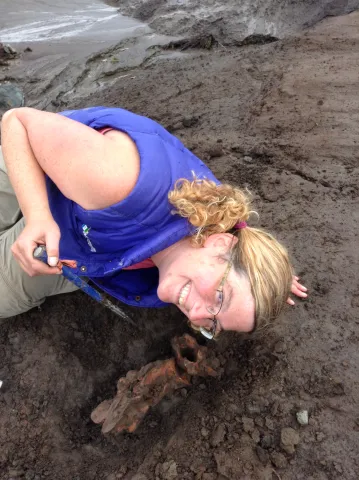
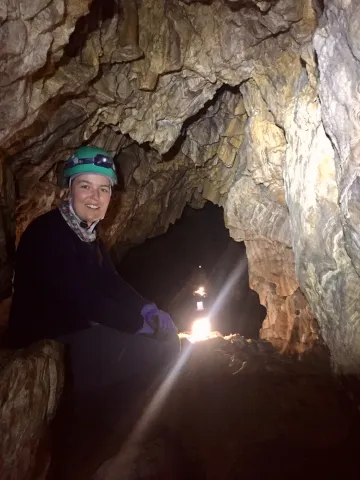
Jodie - I love that my current role lets me do a variety of things. A highlight is getting to be a part of different archaeological projects across the Yukon - such as excavations at the Bluefish Caves (near Old Crow) or monitoring erosion at sites along Yukon’s arctic coastline. Being able to support researchers and work collaboratively with First Nations on projects has been a valuable learning experience, and it’s been meaningful to contribute to a team that’s helping advance archaeology in the Yukon.
Susan - That it doesn’t feel like a job!
Was there a particular person, experience, or moment that inspired you to pursue a career in STEM?
Elizabeth - In grade 11, I circulated a petition at F.H. Collins to reinstate the Earth Science 11 course. I wanted to learn about the physical aspect of the earth and get a science credit that wasn’t the standard science courses that at that time, which I wasn’t inspired by (at the time). Both an Earth science 11 and Geology 12 were offered, I took both and then I took all the other science courses. It’s been science science science ever since.
Jodie - I did two years of experiential science programs during high school in Whitehorse and spending so much time doing field‑based environmental work showed me how much I loved learning on the land. That experience pushed me to pursue environmental studies in university. When I was choosing my first courses, my mom encouraged me to take an anthropology class. I didn’t even know what it was, but after learning it was the study of humans, I signed up out of curiosity. I ended up loving it, and that interest is what led me to major in both fields and eventually into the career I have today.
Susan - I cannot say there was a single moment that pushed me toward STEM, but I had parents who were teachers and I grew up on a farm. I had an early instinct to be outside and be part of the environment, and I was a curious kid who asked ‘why’ a lot. Luckily, the adults in my world encouraged inquisitiveness and helped guide me on how all sorts of systems work. I always loved the smell of an intense thunderstorm and freshly worked soil, so I know that had something to do with becoming an archaeologist, ha! That, and my mom says she used to dress me last when we would go anywhere because I was constantly dirty or into something.
What does being a woman in science mean to you or why do you believe women’s participation in science matters?
Elizabeth - There are so many women in science who inspire me, past and present, some whose stories are just coming to light, whose contributions have been credited to others. It’s important that women’s stories and contributions are seen and heard so that other aspiring scientists (regardless of gender) are inspired.
Jodie - I think it’s important to see all kinds of people in science, because it shows you that you can belong there too. Many of the pioneers of Yukon archaeology and anthropology are women, and they did foundational work that still shapes the field today. I was lucky to have strong female mentors in the field, and learning from women who were doing the work and excelling at it made it much easier to see a place for myself in it too.
Susan - To me, being a woman in science begins with the simple truth that women often move through the world with a different kind of synchronization. At a certain point in all our lives we are subjected to an innate schedule beyond our control. Though we initially fight it, and whether covert or subconscious, it quietly trains our attention to the world around us. We begin noticing patterns/non-patterns, and for some of us these become pebbles of curiosity we find distractingly hard to ignore.
Being a woman in science means pushing aside pressures to ignore and suppress and giving oneself space to find answers for those pebbles of curiosity that fit/don’t fit the patterns we expect. Women’s participation in science matters because our ways of seeing add dimension to the collective understanding of the world and makes it a more complete picture.
What message would you give to women and girls looking to pursue a career in STEM?
Elizabeth - Don’t ever let someone (including yourself) stop you from pursuing your passions. It might not be easy and you may even change your mind (I have) but if you open your heart and mind up to the possibilities, you just might find yourself.
Jodie - Don’t be afraid to ask lots of questions and reach out to women who are already in the field, most of us are happy to share what we’ve learned. If you’re in the Yukon, student programs like STEP are a great way to get hands‑on experience and see what the work is really like. Different perspectives make science stronger, and women absolutely belong in these spaces.
Susan - So many women talk themselves out of their own curiosity long before anyone else has the chance to do so. We are taught to second-guess the questions that feel “silly” or “obvious” or “too small”. But, those are the questions worth following. If something keeps tugging at your attention, don’t dismiss it- explore it!
Maybe someone has asked the same question before. Fine. Look it up. Learn what’s already known. Then build from there like you are in an improv scene and say, “Yes, and?” What other patterns/non-patterns do you see? What insights can YOU bring to make the collective understanding of the world around us more complete?
Stay curious. Stay bold. And, trust that your questions are worth pursuing.
----
Elizabeth Hall is a Palaeontologist with the Yukon Palaeontology Program (YPP). Her love of ancient remains began as young child growing up near Dinosaur fossils in Calgary and transitioned into Ice Age mammals when she began her STEP position with YPP. She credits her love of science and history to her parents who filled their house with books and took her and her siblings on many outdoor adventures. She loves fossils so much that even when she is travelling, she seeks them out.
Jodie MacMillan is an archaeologist with the Government of Yukon and has worked in the Yukon archaeology field since 2011. She earned a Master of Arts in Heritage Resource Management from Simon Fraser University in 2019. Her research focused on subalpine and alpine archaeology in southeast Yukon, reflecting her long‑standing interest in high‑elevation landscapes and the unique insights they offer into the past.
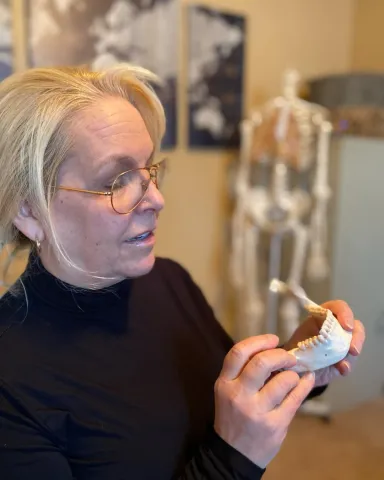
Susan Moorhead Mooney is a human osteologist and archaeologist with over two decades of experience working across government agencies, academic and research institutions, First Nations communities, private consulting firms, public stakeholders, special‑interest groups, and political representatives. She currently manages the Yukon Beringia Interpretive Centre, where she gets to combine her love of science and passion for public education. Over the course of her career, she has analyzed more than 1,100 sets of human remains, and she is deeply committed to giving voice to individuals whose stories can no longer be told firsthand.